
Permission for Wellness
Submitted by Della Massey and Laureen Guldbrandsen
Submitted by Della Massey and Laureen Guldbrandsen
Earlier this month we started our third series of Wellness Lunch & Learn sessions. And what a great session it was! We explored personal protective factors which are basically the things we have control over when looking at our wellness. And we all know how important wellness is! In fact, several years ago CLN received a grant which allowed us to offer a two-day Psychological First Aid training through the Canadian Red Cross that focused on how CALP staff can support themselves and others to cope with the various effects of stress.
This training was such a hit and brought up some fantastic insights amongst participants. One thing we heard again and again was that people wanted to keep having conversations about these concepts and how to apply them in their everyday lives. And thus, the Wellness Lunch & Learn series was born!
Now in our third series, we’re taking a deeper dive into the six categories of protective factors introduced in the Canadian Red Cross Psychological First Aid course. Each month we will be focusing on one of these categories and exploring what they mean for us, because each of these areas are important for our wellbeing.
In this first session we focused on personal, personal factors.
In this first session we focused on personal, personal factors. Personal factors are all about you. What’s important to you? What do you love to do? What empowers you? What energizes you? What gives you confidence and simply makes you feel good? What matters most to you?
This is a very personal list that may look different for everyone because what matters to each of us is unique.
It may include:
- Connecting with a friend
- Journaling
- Taking a course or class (cooking, writing, dancing, skiing, etc.)
- Spending time alone
- Spending time in nature
Taking time to reflect on what matters to us is a valuable use of our time and an important part of supporting our wellness. But sometimes, even when we know something is good for us, actually doing it can be challenging. Maybe we're too busy, maybe we're uncomfortable, or maybe we feel like other things need to come first.


We might need to give ourselves permission to prioritize our own needs.
What? Permission?? But we’re adults. (I checked. My licence says I am, in fact, an adult.) But isn’t permission for children?
Interestingly, Brene Brown talked about the importance of giving ourselves permission slips in her books Braving the Wilderness and Dare to Lead. In a conversation with Oprah, she shared that all her outfits have pockets so she can carry the permission slips she’s written for herself. These slips weren't about big things. They were about giving herself permission to be excited and giddy when she met Oprah, to laugh, and even to be uncool.
What a great reminder that giving ourselves permission doesn't have to be about making some huge change in our lives. Sometimes, it’s about giving ourselves the power to do what’s important to us and what will make us feel well.
This idea of giving ourselves permission came up in a creative bullet journaling workshop I (Laureen) attended, too. One of the first pages we created in our journals was a Creative Declaration, which started with giving ourselves permission to play, be curious, and experiment. The instructor described this declaration as a way of holding ourselves accountable. By reading and signing it, we were making a commitment to return to our bullet journals, keep playing and being creative, just for ourselves.
What do you need to give yourself permission for?
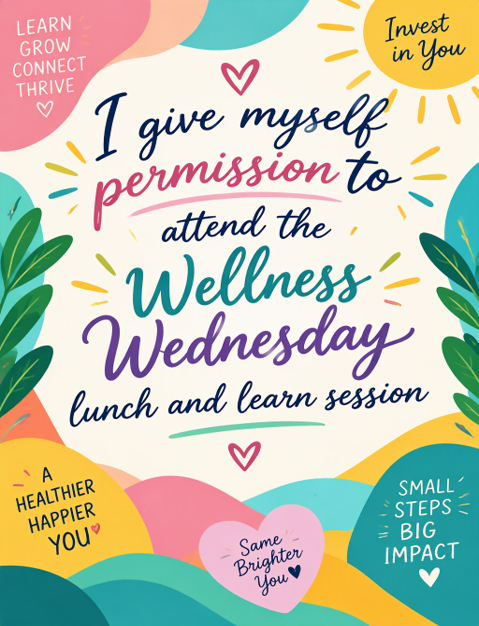
During our first session, we invited participants to create their own permission slips. We’d like to invite you to give it a try, too!
- Think about a time in your life where you wanted to do or say something but didn’t for fear of embarrassment or looking foolish
- Keeping those moments in mind, write a permission slip for yourself using the sentence starter “I give myself permission to…” (or download the image on the right and write directly on it)
- Put your permission slip somewhere you’ll see it often.

Working in the nonprofit world, we tend to spend a lot of our time supporting others. We’re passionate about the work that we do and the people we serve, but sometimes that means our own wellness gets pushed further down the list of priorities.
We get it! There’s always someone new coming through the door, a deadline approaching, or another thing to do. It’s easy to tell ourselves that we’ll take that break after we’re done this one thing. (Or is that just me?)
But wellness isn’t something we should only think about when we are already overwhelmed. Instead, it’s a practice that we build through small, intentional choices we make every day to support our wellbeing. Building that practice starts with giving ourselves permission to make the time.
Wellness Wednesdays are one way to build or expand your wellness practice, and we would love for you to join us
Wellness Wednesday Lunch & Learn
Our lunch & learn sessions are 50 minutes long, held over the lunch hour once a month, and will explore the protective factors introduced in the Canadian Red Cross Psychological First Aid training.
Bring your lunch, bring a friend, or just bring yourself!
- December 2: Spiritual: Finding Meaning, Purpose, and Connection
- January 13: Psychological: Supporting a Healthy Mindset
- February 10: Emotional: Understanding and Managing Emotions
- March 3: Professional: Enhancing Wellbeing at Work
- April 7: Physical: Caring for Your Physical Wellbeing
Wellness Wednesday Tips
Keep an eye on the CALP Forum on the Portal for our Wellness Wednesday Tips! Every Wednesday we’ll be sharing tips, ideas, and suggestions to help you support your wellness.
We’d also love to hear what works for you! Share your own wellness tips in the comments below, and they may even be featured in a future Wellness Wednesday Tip.
Whether you join us for a Wellness Wednesday session, try out a wellness tip, or just take a little time for yourself during a busy day, we hope you’re giving yourself permission to make your own wellness a priority.